
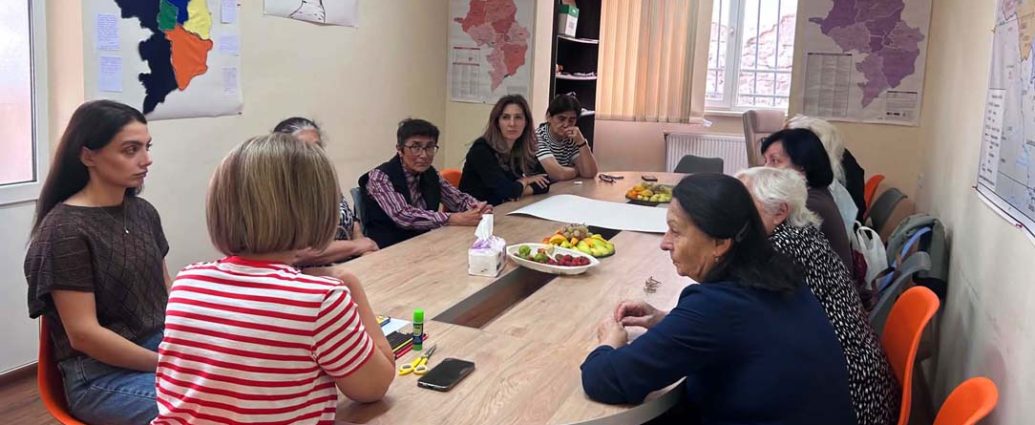
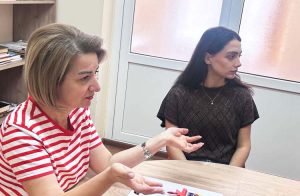
 Another warm and meaningful psychological group therapy session was held at Hanganak Charity NGO, led by Dr. Anahit Lalayan, Head of the Empathy Mental Health Center. This time, she was joined by Hripsimeh Avetisyan, a young psychologist from the Empathy Mental Health Center, who participated in and assisted with the session.
The meeting invited our older participants to express feelings that are sometimes difficult to put into words. Using a creative hand-based expressive exercise, each participant traced the outline of their hand on a sheet of paper. They were then encouraged to reflect on their emotions and experiences, write their thoughts within the fingers, and use different colors to give visual expression to what they were feeling.
Soon, the table was filled with pencils and crayons—and with concentration, conversation, memories, and emotion.
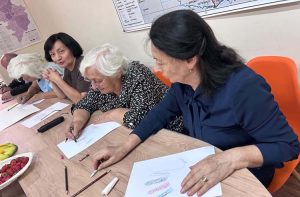 For older adults who have experienced forced displacement from Artsakh, such an exercise can offer another way of expressing what is held deeply inside. Behind the words and colors were memories of home and family, the pain of loss and separation, the uncertainty of rebuilding life in a new environment, but also affection, gratitude, inner strength, and hope.
For many of our participants, Artsakh remains much more than a place they were forced to leave behind. It is home—the landscape of their childhood, their family histories, familiar streets and neighbors, traditions, and a lifetime of memories. During Hanganak’s psychological sessions, this deep attachment often finds expression alongside the challenges of adapting to life after displacement. The hope of one day being able to return to Artsakh remains deeply present in the hearts of many of our elders.
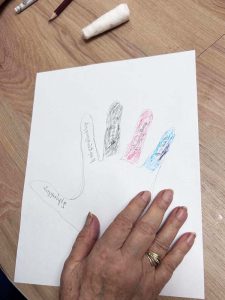
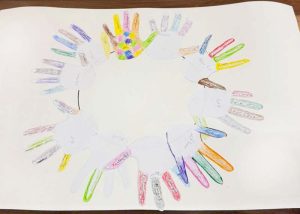 Yet the session was not only about loss. The different colors chosen by participants created space for the full range of emotions they carry today. Rather than assigning one fixed meaning to each color, participants were able to use them in their own personal way, expressing what mattered to them at that particular moment.
One especially beautiful part of the exercise came when the individual hand drawings were brought together on a large sheet of paper, forming a circle of hands. Each hand remained unique, carrying its own words, colors, and story, while together they became part of something larger.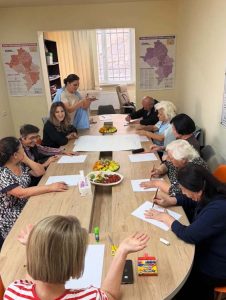
The shared image beautifully reflected the spirit of Hanganak’s group meetings: each person carries an individual story of loss, resilience, memory, and hope, but no one has to carry that story alone.
These weekly gatherings are more than activities. They provide a safe and caring space where displaced older adults can speak, listen to one another, remember, create, and experience the comfort of belonging to a community that understands much of what they have lived through. Through these moments of expression and connection, participants are encouraged not only to acknowledge painful experiences, but also to recognize the relationships, memories, and inner resources that continue to give meaning to their lives.
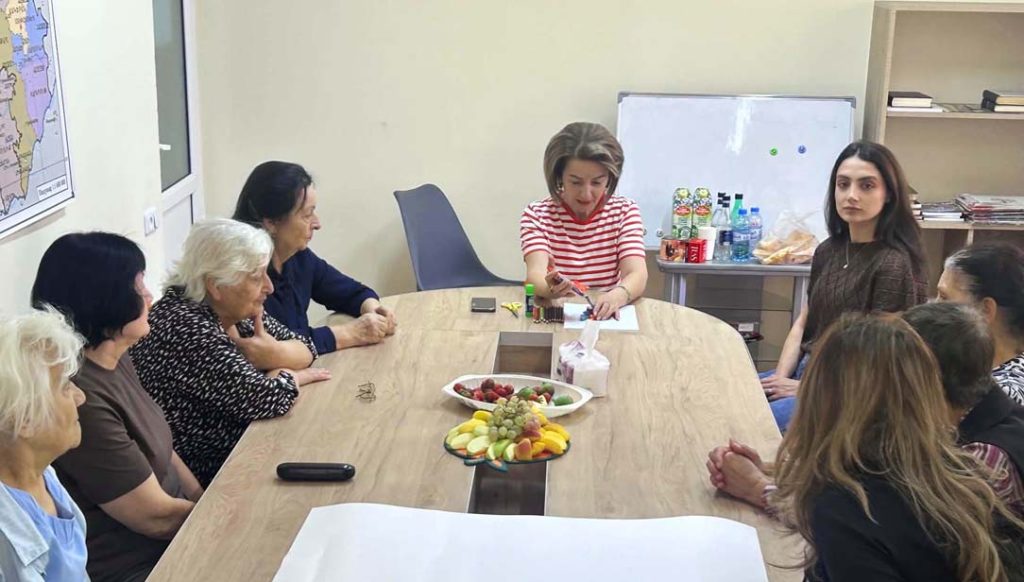 We sincerely thank Dr. Anahit Lalayan for her continued dedication to our older adults and Hripsimeh Avetisyan for joining the group and contributing her warmth and professional support. We are also deeply grateful to our partner, the Empathy Mental Health Center, for its continued collaboration in supporting the psychological well-being of Hanganak’s beneficiaries.
Our deepest gratitude goes to the Armenian Women’s Welfare Association (AWWA), Hanganak’s main sponsor and longstanding supporter. Its generous and continued partnership makes it possible for us to sustain our work with displaced older adults from Artsakh. AWWA’s support enables Hanganak to provide not only essential medical and social assistance, but also psychological support, human connection, and opportunities for meaningful participation—all of which are so important to the well-being and dignity of older people rebuilding their lives after displacement.
The hands created during this session may look simple on paper, but together they tell a much deeper story—a story of people who have lost their homes but continue to hold tightly to their memories, to one another, and to hope.
Hope for peace. Hope for healing. And, in the hearts of many, hope that one day the road may lead home again.